


Changing Cardiovascular Medicine
As one of the most common abnormal heart rhythms, atrial fibrillation (or AFib) affects more than 38 million people across the globe. In the 1980s and 1990s, breakthroughs in AFib treatment came in the form of catheter ablations. Now, further advancement in cardiovascular treatments has put pulse field ablation (PFA) on the map as a promising new alternative to standard radiofrequency ablation and cryoablation.
How Does PFA Measure Up?
According to John Hopkins Medicine, compared to standard ablation techniques, PFA is safer and more effective. Here’s how it stacks up against traditional treatments.
- Lower Damage Risk: Where radiofrequency ablation and cryoablation result in thermal damage to the esophagus, lung nerves, and other tissues, PFA uses electrical pulses without localized damage to the surrounding tissue.
- Quicker Procedure: Traditional ablation often takes between three and five hours to complete the procedure, whereas PFA can be successfully completed in as little as one to three hours.
- Safe and Effective: Although PFA is a newer treatment on the market, clinical data has shown it to be effective when compared to traditional treatments, making it a promising medical advance.
Investment is Heating Up
In response to these recent advancements, MedTech companies have begun pouring investments into PFA technology. A Canadian MedTech company called Kardium recently raised $250 M in investments, and a Californian company, Field Medical, raised $35 M. Other companies like Boston Scientific hold a leading position in the market.
To keep up, medical device companies will need to enter phases of rapid development to maintain a competitive edge. This is where Medical Component Specialists is uniquely equipped to come in.
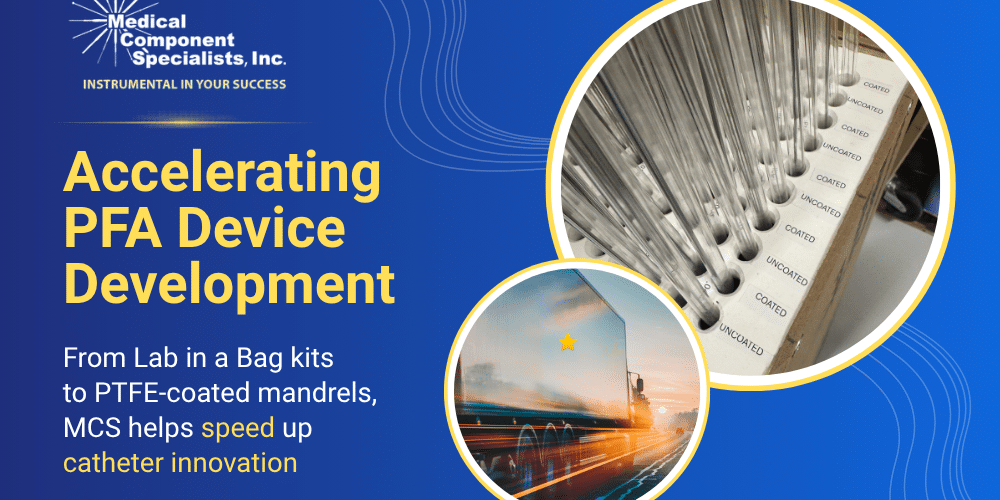
Part of our QuickShip Program, our Lab in a Bag is designed to help medical device companies rapidly accelerate their time to market and streamline development. Each Lab in a Bag kit comes with 30 catheter-forming mandrels in various sizes, offering a flexible, all-in-one solution for rapid prototyping and catheter R&D; essential for catheter-driven PFA.
Shipping out as soon as the next day, our Lab in a Bag kit supports an array of diverse engineering requirements, such as multi-lumen, steerable, neuro, structural heart, and laser-cutting catheter builds.
To help bring complex designs to life or for high-friction requirements, our mandrels are made from 304 stainless steel and coated with performance PTFE that offers effortless release. Each precision-ground part is manufactured in our FDA-registered facility to meet ISO13485 standards, ensuring full lot traceability and complete certification.
When you need catheter forming mandrels for PFA devices, and you don’t have the luxury of time, Medical Component Specialist is ready with our QuickShip Program to ensure you have the products you need, when you need them, skipping the line and avoiding long lead times.
To learn more about our Lab in a Bag or our QuickShip Program, get in touch with our experts today.

